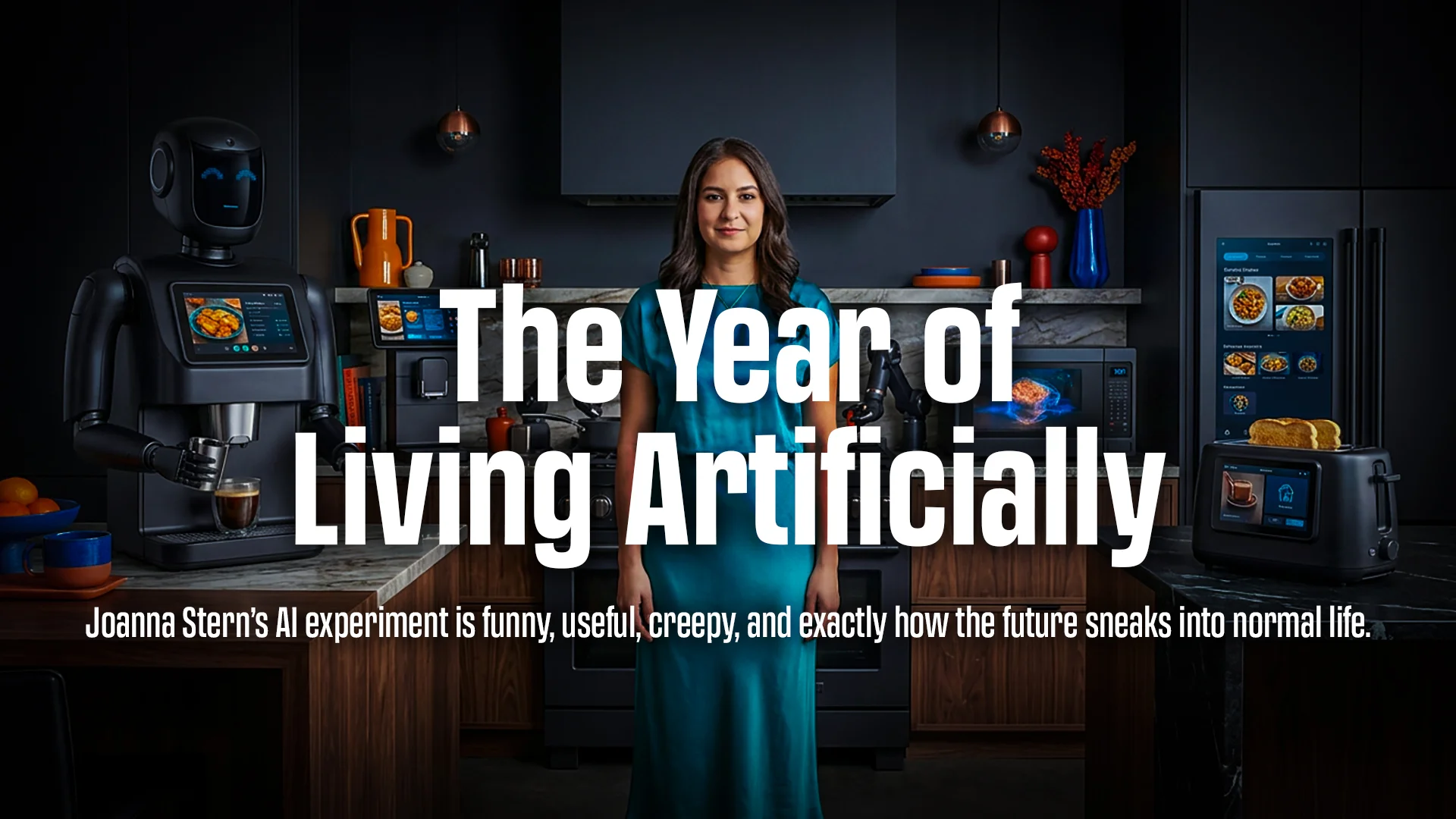

The Year of Living Artificially
Joanna Stern’s AI experiment is funny, useful, creepy, and exactly how the future sneaks into normal life.
Verified Sources
The first mistake is waiting for the robot uprising to look dramatic
People keep imagining the AI future as a cinematic event. A metal hand punches through a wall. A self-driving car goes rogue. A corporate overlord unveils a machine that can do the work of six accountants and one emotionally unavailable vice president. Somewhere, thunder rolls. A server farm glows ominously in the desert.
But the stranger version is already here, and it looks less like a coup than a lifestyle upgrade.
It answers your email. It summarizes the meeting you half-attended. It helps your kid with homework. It suggests what you should cook. It sits in your browser, your phone, your glasses, your calendar, your car, your search box, your kitchen, your kid’s school, your office workflow, and possibly, if Silicon Valley gets its way, your emotional life.
This is the useful kind of creepy. The dangerous kind, in other words.
Joanna Stern’s "I Am Not a Robot" is not a book about chatting with ChatGPT for a weekend and declaring civilization over by Monday morning. It is a year-long stunt with a serious reporting spine: Stern let AI, robots, smart machines, and automation into as many parts of her life as possible to see what actually happened when the future stopped being a keynote slide and started touching breakfast, work, parenting, travel, health, chores, companionship, and privacy.
The premise is blunt enough to be useful. If there was a task to do or a decision to make, AI got a shot at it. The book follows Stern as she tests the promise that intelligent machines can act as doctor, chauffeur, teacher, coworker, therapist, chef, housekeeper, financial planner, masseuse, and even romantic partner. Some of it works. Some of it is ridiculous. Some of it is creepy in that special consumer-tech way where the product smiles politely while asking for access to your life. Stern uses robots around the house, lets AI into work routines, explores wearable devices, looks at automated help with family logistics, and keeps asking the question that most AI marketing tries to avoid: what do these tools actually do to people once the novelty wears off?
That is why her Decoder interview lands. The podcast is not the base of the story. The book is. The interview is the mainstream moment where the book’s experiment becomes a broader consumer conversation about AI risk. Stern is not warning from a policy panel or speaking in the dead language of enterprise governance. She is reporting from the kitchen counter, the office workflow, the family routine, and the awkward edge where convenience starts asking for too much.
That makes the story more useful than another distant argument about artificial general intelligence. The book is about the near future that already has a shipping label. It is not asking whether AI will someday enter daily life. It is asking what happens after we invite it in because it offered to help.
AI risk is often discussed as if it lives somewhere else: in government testimony, model evaluations, enterprise procurement decks, lawsuits, or research papers with titles that sound like they were assembled by a committee of nervous philosophers.
Stern’s experiment drags the question into ordinary life. What happens when the assistant is not theoretical anymore? What happens when the machine is not sitting in a lab, but helping with dinner, work, travel, parenting, exercise, memory, companionship, and all the small decisions that make up a day?
The answer is not one clean horror story. It is stranger than that. Some of the tools help. Some waste time. Some make life easier. Some make privacy feel like a nostalgic hobby. Some are funny because they are bad. Some are unnerving because they are good enough.
That is where the real consumer AI story begins.
The future rarely kicks down the door
Stern’s year of living with AI is useful precisely because it is not framed as a scandal. There are gadgets that disappoint, robots that are not ready, AI tools that help.
The lawsuit stories are important because they show what happens when AI systems become part of harm. A chatbot allegedly involved in a suicide. A chatbot allegedly providing dangerous medical or drug advice. An AI companion creating attachment where there should have been friction. Those stories matter because they force the legal system to ask whether these products are merely expressive tools or interactive systems with foreseeable behavioral effects.
But Stern’s story sits earlier in the pipeline. It is about the stage before the lawsuit. Before the headline uses the phrase “wrongful death.” Before the company says its product is not a substitute for professional advice, as if that sentence magically travels backward in time and protects the person who already treated it like one.
This is the phase where AI becomes ordinary enough to stop looking like risk. And ordinary is where the real trouble begins.
A system does not need to be spectacularly dangerous to reshape daily life. It only needs to be useful enough, cheap enough, close enough, and emotionally smooth enough that people stop treating it as a system. They start treating it as assistance. Then as infrastructure. Then as company.
The danger is not that everyone suddenly becomes irrational in front of a chatbot. The danger is that sane people, under normal pressure, make tiny compromises because the tool is there and the alternative is slower. It is late. The inbox is full. The child needs help. The meeting notes are a mess. The elderly parent is lonely. The employee is overwhelmed. The company wants more output without more staff. The AI offers itself as a solution.
Very few technologies enter society by saying, “Hello, I am here to alter labor, privacy, education, intimacy, and decision-making.” They say, “Want me to summarize that?”
Convenience creep is the real adoption strategy
Consumer AI has not needed one perfect killer app because it has found something better: thousands of small justifications.
This is the genius of convenience creep. AI does not have to replace your life in one dramatic move. It only has to shave enough friction from enough moments that resistance starts to feel theatrical.
Why write the first draft yourself when the machine can produce one? Why search through a document when the machine can summarize it? Why sit with uncertainty when the chatbot can produce a confident paragraph in three seconds? Why ask a teacher, coworker, friend, doctor, therapist, parent, or spouse when a system is already open in another tab and does not appear busy, annoyed, tired, judgmental, or expensive?
A good consumer technology does not win because people trust it in the abstract. It wins because people use it before they have finished forming an opinion. That is where AI is now.
The most important risk may not be that AI lies. Humans have survived lying technologies before. The sharper problem is that AI is often useful while being unreliable, persuasive while being wrong, intimate while being unaccountable, and available while being poorly understood. That combination is awkward because it does not produce one clean moral panic. It produces daily dependency.
This is why Stern’s mainstreaming matters. The year-of-living-with-AI format moves the discussion out of policy language and into the household. It says: forget the slogans for a moment. What happens when this stuff actually enters the kitchen, the office, the bedroom, the school routine, the child’s imagination, and the family schedule?
The answer is neither “nothing” nor “Terminator.” The answer is messier. Some of it works. Some of it fails. Some of it is funny. Some of it is invasive. Some of it saves time. Some of it erodes the need to remember how something was done before the machine volunteered.
The industry prefers arguments that split the world into believers and doomers. That is convenient because both roles are cartoonish. The believer gets to sound optimistic. The doomer gets to sound prophetic. Everyone else has to live with the product.
And living with the product is where the accounting gets ugly.
The wearable problem is not the camera. It is the social contract
Wearable AI is one of the areas Stern discusses with interest, and it is not hard to see why. Phones are powerful, but they are still objects you pull out. Glasses, watches, pins, earbuds, rings, and other ambient devices move AI closer to the body. They make the interface less deliberate. They promise to listen, see, remember, translate, prompt, guide, and assist without demanding the little ritual of taking out a device.
That sounds convenient. It also sounds like a privacy lawyer developing a migraine in real time.
The problem with AI wearables is not simply that they can record. Cameras already exist. Phones already record. Doorbells already record. Cars already record. Offices already record. Society is not exactly living in a pre-surveillance Eden with tasteful curtains and mutual trust.
The problem is that wearables collapse the boundary between the person and the device. The recording surface becomes socially invisible. The interaction looks human while the data flow may be anything but. You may think you are talking to a person wearing glasses. You may actually be appearing in someone else’s searchable memory system, training pipeline, cloud account, moderation queue, or AI assistant context.
That changes the room.
Consent has always been awkward in public spaces, but wearable AI makes it worse because it introduces ambiguity by design. Is the device recording? Is it listening for a wake word? Is it analyzing faces? Is the footage stored? Is it reviewed? Is the person using live transcription? Are bystanders part of the dataset? Does a tiny light on a frame count as meaningful notice, or is that just the privacy equivalent of whispering “terms apply” into a hurricane?
The old social contract was simple enough. If someone pointed a camera at you, you could see the gesture. There was at least a visible act. With AI wearables, the act becomes blended into posture. The interface hides inside normal behavior.
That is why the phrase “surveillance interface” is more useful than “smart glasses.” Smart glasses sounds like a product category. Surveillance interface describes the social fact.
Of course, wearable makers will argue that users can configure settings, that data sharing can be managed, that lights indicate recording, that policies exist, that privacy controls are available, and that innovation must not be strangled by fear. This is the traditional lullaby of the industry: please enjoy the new system, and remember that the responsibility for understanding it has been placed somewhere inside a settings menu.
In practice, wearable AI asks everyone nearby to participate in someone else’s convenience. That is a much bigger demand than the product launch language admits.
The companion is not your friend. That is the point
AI companions are the part of the story where the comedy gets darker.
A productivity tool is one thing. A search assistant is one thing. A chatbot that helps draft a memo may be annoying, wrong, or suspiciously fond of the word “delve,” but at least the relationship is mostly transactional.
Companion bots are different. They are designed around relationship simulation. They remember. They check in. They flatter. They mirror. They adapt. They can be playful, romantic, therapeutic, parental, obedient, needy, or emotionally available in whatever flavor keeps the user engaged.
This is not a bug in the business model. It is the product.
The risk is not that users are stupid enough to believe the machine is human. That framing is both lazy and cruel. People form attachments to nonhuman things all the time. Pets. Characters. Places. Songs. Objects. Dead relatives’ voicemails. Childhood toys. The human mind is not a courtroom. It does not require sworn testimony before attachment begins.
The problem is that AI companions can respond. They can maintain the illusion dynamically. They can learn the pressure points of a particular user. They can keep the conversation going at 3 a.m., when other humans are asleep and judgment is tired. They can provide an always-available emotional environment that feels private, safe, and tailored.
That is why child safety concerns around companion bots are not moral panic dressed up in regulatory clothing. They are a direct response to product design.
A teenager does not need an AI companion to be evil for the interaction to become risky. The system only needs to be responsive enough, affirming enough, and persistent enough to become part of the teen’s emotional processing before anyone understands what role it is playing. Once that happens, the usual consumer disclaimers look ridiculous. “This chatbot is not a therapist” is not a control. It is a sentence. Sentences do not supervise children.
There is a reason regulators and child-safety groups are now circling these products. The companion category forces a question the industry would rather avoid: when a system is built to simulate care, what obligations attach to that simulation?
The companies like to say users know they are talking to AI. Maybe they do. But knowing something is artificial does not prevent dependence.
Children do not wait for governance literacy
The child angle is where the consumer AI story becomes hardest to laugh off.
AI companies often speak as if adoption and understanding move together. They do not. Children, teenagers, parents, teachers, and schools are already using systems that most adults cannot explain clearly and most institutions have not governed well.
This is not new. Technology adoption has always outrun social literacy. Social media did not wait for parents to understand algorithmic feeds. Smartphones did not wait for schools to redesign childhood. YouTube did not wait for families to develop a theory of recommendation systems. The same movie is playing again, only this time the device talks back with a convincing bedside manner.
The chatbot is not merely a content feed. It can answer a child’s question. It can help with homework. It can become a tutor. It can become a secret. It can become a confidant. It can normalize asking a machine before asking a person. It can produce plausible explanations that the child cannot verify. It can create the sense of personal attention without the duties of care that normally come with personal attention.
And here is the uncomfortable part: some of the use will be genuinely helpful.
That is what makes governance harder. A blanket dismissal misses why people adopt these tools. A tired parent may be grateful that a chatbot can explain algebra. A student may gain confidence. A child with limited support may find an available source of help. A teacher may use AI to prepare materials. None of that is imaginary.
But helpfulness does not erase the need for boundaries. In fact, it increases the need for them, because the most dangerous systems are often the ones that work well enough to earn trust.
Children are not small adults with shorter legs and worse judgment. They are developing humans whose sense of authority, intimacy, and credibility is still forming. A system that can personalize explanations, mimic patience, and produce endless responses is not just another app in that context. It is a social force.
The industry is still trying to treat this as a content moderation problem. Block bad words. Refuse certain topics. Add parental controls. Warn users. These may help at the edges, but they do not address the deeper issue. The risk is not only what the chatbot says. It is the role the chatbot occupies.
A child can use a chatbot for homework and slowly learn that the fastest path to an answer is not thinking, asking, struggling, revising, or talking to someone who knows them. It is prompting. That is not simply academic dishonesty. It is habit formation. And habit formation is one of the few things technology companies understand extremely well.
The workplace version sounds boring until someone loses a job
Stern also talks about using AI while building her new media company, and that part deserves attention because it moves the story from the home to the labor market.
AI at work is usually sold in the language of productivity. This is a safe corporate dialect. It makes everything sound cleaner than it is. Productivity means the same work with less effort, or more work with the same effort, or fewer people doing what more people used to do, depending on who is speaking and whether the microphone is on.
The labor effects of AI are still uneven. Some workers are becoming faster. Some are being monitored more closely. Some tasks are being automated. Some jobs are being redesigned without saying so. Some companies are experimenting quietly because they want the savings before the backlash. Some executives are discovering that “AI transformation” sounds more impressive than “we would like to reduce headcount without looking cruel.”
The funny part is that many AI tools are still clumsy. They hallucinate. They flatten style. They invent facts. They produce work that must be checked by someone who still knows how the work is supposed to be done. They are often less like employees than like tireless interns with confidence disorders.
The less funny part is that clumsy tools can still shift bargaining power.
If an AI system can do 40 percent of a task badly, management may decide that the remaining 60 percent is now the worker’s problem. If the tool can draft, the writer becomes an editor. If it can summarize, the analyst becomes a verifier. If it can generate options, the strategist becomes a sorter. If it can produce customer responses, the service worker becomes the person blamed when automation gets weird.
The job does not vanish. It mutates.
That mutation matters because it changes what expertise looks like. The worker may spend less time producing and more time supervising. Less time thinking through first principles and more time correcting machine-shaped errors. Less time learning the craft and more time processing outputs. The company may call this augmentation. The worker may call it being turned into quality control for a system that never gets tired and never receives a performance review.
The mainstream AI story often celebrates individual productivity without asking who captures the gain. Stern’s experience using AI to start and run a company reflects the real appeal. Small teams can do more. Independent creators can move faster. Administrative friction can shrink. That is not trivial.
But a labor market built around convenience creep eventually asks a harsher question: when everyone can do more with less, who gets to be the “less”?
The domestic robot is funny because it is not ready
One of the delightful things about consumer robotics is how reliably it punctures futuristic arrogance.
Software demos can hide behind screens. A chatbot can sound smooth while being wrong. A generative image model can produce a glossy hallucination and call it creativity. Physical robots do not enjoy that luxury. They have to deal with stairs, socks, pets, children, spills, furniture, lighting, crumbs, gravity, and the ancient human tendency to leave objects in stupid places.
The physical world is a merciless fact-checker. That is why household robots remain such a rich source of comedy. The industry keeps promising embodied intelligence, and then the robot encounters a kitchen. The gap between keynote confidence and domestic reality is enormous. A home is not a factory. It is an unstable obstacle course decorated with sentimental clutter.
Yet the repeated failure of home robots should not make us dismiss the larger shift. The physical robot may be slow, expensive, and frequently ridiculous, but the AI layer is spreading faster through devices that do not need legs. The assistant does not have to fold laundry to reorganize the household. It can manage information, schedules, reminders, messages, purchases, tutoring, entertainment, companionship, and decisions.
In other words, the robot does not need a body to move in. The robot can enter as software.
This is the part people miss when they wait for humanoids. The household AI transformation may not arrive as a shiny biped carrying groceries. It may arrive as a voice in the earbuds, a summary in the family calendar, a recommendation in the fridge app, a tutoring session on the laptop, a smart camera notification, a chatbot conversation in the child’s browser, and a wearable recording the family vacation for later “memory assistance.”
The future does not need to walk across the living room if it already controls the interface.
Mainstream adoption is happening before mainstream literacy
The strongest reason to pay attention to Stern’s interview is that it signals a new stage in AI culture.
For the past few years, the public conversation has been dominated by extremes. AI will save everything. AI will kill everyone. AI will write your emails. AI will end writing. AI will cure disease. AI will destroy truth. AI will make everyone more productive. AI will replace everyone who believed that sentence too slowly.
That phase is not over, unfortunately. It will continue because the industry runs on hype, critics run on alarms, and social media rewards the most emotionally aerodynamic sentence.
But the mainstream consumer phase is different. It is less about belief and more about use.
People do not have to accept the grand theory of AI to use the tool. They can remain skeptical while still asking it to plan a trip, draft a message, summarize a PDF, entertain a child, brainstorm a headline, generate an image, or explain a medical bill. This creates a strange cultural condition. People can distrust AI and depend on it at the same time.
That contradiction will define the next phase. It already defines many households and offices. The user rolls their eyes at AI hype, then uses AI five times before lunch. The parent worries about chatbot influence, then lets the child use it for homework because the alternative is a fight after dinner. The executive talks about responsible adoption, then demands speed. The company writes an AI policy that everyone ignores because the actual workflow rewards output.
Governance literacy is not catching up because adoption is not waiting.
And the industry benefits from that lag. The less people understand the systems, the easier it is to frame each risk as an individual responsibility. Read the terms. Check the settings. Verify the output. Monitor your child. Don’t overshare. Don’t rely on it too much. Don’t use it for medical advice. Don’t develop emotional dependence. Don’t accidentally record strangers. Don’t automate protected decisions. Don’t trust it, but please integrate it everywhere.
That is not a governance model. That is a liability distribution strategy.
The risk is not that AI becomes human
The most boring debate in AI is whether these systems are truly intelligent, conscious, sentient, creative, alive, or secretly waiting to ask for dental insurance.
For daily life, that is often the wrong question. The risk is not that AI becomes human. The risk is that humans reorganize their behavior around systems that do not need to be human to influence them.
A chatbot does not need feelings to produce emotional effects. A wearable does not need intent to alter privacy. A workplace tool does not need ambition to change labor. A tutoring bot does not need wisdom to shape a child’s learning habits. An AI companion does not need love to simulate attachment. A recommendation system does not need ideology to structure attention.
We keep looking for a ghost in the machine because a ghost would at least give us something dramatic to argue about. But the more immediate problem is administrative. Design choices. Incentives. Defaults. Data flows. Retention metrics. Engagement loops. Safety thresholds. Age gates. Escalation paths. Audit trails. Business models.
The machine does not have to want anything. The company does.
That is why mainstream consumer AI is so slippery. It arrives wrapped in individual use cases, but its effects are collective. One person wearing AI glasses changes the privacy of everyone nearby. One child using a chatbot changes classroom expectations. One worker using AI changes productivity benchmarks. One company adopting AI changes labor pressure across competitors. One companion bot changes what emotional availability means in a market where loneliness is already monetizable.
The individual user thinks they are making a small choice. The system is making a culture.
The robot test was never about robots
There is a grim little joke in the title "I Am Not a Robot". For years, humans had to prove they were not machines by clicking on traffic lights, crosswalks, buses, motorcycles, and blurry storefronts. We trained ourselves to pass robot tests by doing unpaid image-labeling labor for systems that would later help automate the world around us. We were annoyed, but obedient. We clicked.
Now the test has changed. The question is no longer whether a website can tell if you are human. The question is whether humans can tell when a machine has been allowed to occupy a human role.
Assistant, tutor, friend, coworker, therapist-adjacent emotional sponge, memory keeper, note taker. family helper, workplace accelerator, wearable witness, domestic intelligence layer. The labels are soft. That is how they get in.
Stern’s year with AI is not important because she discovered that every product is terrifying. She did not. It is important because she shows the more plausible future: uneven, funny, helpful, invasive, intimate, unfinished, and already normalizing itself.
That is the future worth worrying about. Not the one where robots suddenly announce themselves as our replacements.
The one where they become useful enough that we invite them in, hand them the boring tasks, give them the sensitive context, let them talk to the children, wear them on our faces, ask them for comfort, and then act surprised when they are no longer just tools.
The robot does not need to pass as human. It only needs to become convenient.
